
概述
Take advantage of our library of mental health articles.
Understanding Menopause and Finding Support
Jessica Allanson, PhD
Menopause is a transition that about half of the population will experience in their lifetime, and which impacts nearly all aspects of an individual’s health and wellbeing. Interestingly, there are only two known mammals that have evolved to survive past their child-bearing years: teethed whales and humans. This unique trait has been explored from a variety of scholarly viewpoints including anthropological, physiological, psychological, and sociological. More recently, menopause has become a more “seen” topic of discussion: on social media, in news articles, scholarly journals, podcasts, etc.
But does that translate to folks feeling like they know more about this experience or make it easier to talk about? Perhaps for some, but not for all.
In fact there have been concerns that the amount of misinformation about menopause in non-regulated spaces (i.e. social media) has been leading to issues in effective care and symptom management for patients in need of support.
So maybe let’s start by talking about talking about it.
Just to give a brief orientation, there are a few basic pieces of information that might be helpful to know. First, the menopausal process is defined in three stages:
- Perimenopause: in this stage, the person’s ovaries produce less of the hormones estrogen and progesterone. On average, perimenopause lasts 4-8 years.
- Menopause: defined as the day in a person’s life that occurs 12 months after their last period (1 year without a period). In the US the average age of menopause is 52.
- Post-menopause: the time period after the point of menopause.
Second, during these stages, people may experience a number of symptoms that noticeably impact their daily functioning, including symptoms of depression, anxiety, difficulty concentrating, forgetfulness, sleep disruption, and changes in mood. However, not all individuals will experience these stages or symptoms in the same way.
For example, approximately 28-38% of people in perimenopause/menopause have reported symptoms of depression, but individuals with a history of depression are 5 times more likely to receive a diagnosis of Major Depressive Disorder during perimenopause.
Additionally, the stages of menopause often overlap with stages of life that can include individual external stressors, such as caregiving responsibilities, physical health challenges, and career/professional pressures. For example, 50% of women between the ages of 45-60 with 15 or more dedicated caregiving hours per week reported moderate or greater menopausal symptoms compared to those with less or no reported caregiving pressures.
Finally, the impact of menopausal symptoms on an individual’s career/workspace (while still a new field of scholarly exploration) is a topic that more people than ever are having to navigate.
67% of women surveyed in the UK reported that their menopausal symptoms negatively impacted their work. Reported impacts in the workplace ranged from having difficulty concentrating, feeling less patient with others, feeling less physically able to carry out work tasks, to feeling an increased amount of stress in general.
Individuals with an identified disability or long-term health condition understandably identified as being even more negatively impacted at work by their menopausal symptoms compared to their colleagues. Almost half of the individuals surveyed also stated that they preferred to keep the cause of any menopausal-related work absences private, citing worries that people would presume their performance would be affected and/or that their colleagues wouldn’t be supportive.
While ostensibly a shared and perhaps a somewhat-expected experience for so many individuals, navigating the stages of menopause can still be isolating for many. From concerns about “what is menopausal vs. circumstantial vs. something else?” to “who can I talk to about this?”, the conversations around menopause tend to be driven by necessity and availability: “what do I need and who should I to talk to about it?”
The experience of figuring out what we or someone we love needs in times of stress can be difficult, and sometimes the best place to start is somewhere. This could mean reviewing your concerns with your friends, a Primary Care professional, OBGYN, or a behavioral health professional. Sometimes starting the conversation ensures that there will be an ongoing discussion.
This article seeks to create some categorical resources for any individuals who are in need of support around menopause. From folks supporting folks, to individuals preparing, experiencing, or transitioning out of menopause, we hope that the following resource menu has something to support you or someone you care about.
The following resources are broken down by common feelings regarding menopause:
- Feeling CURIOUS about menopause:
- For folks who may not have any specific questions or urgency
- For folks who like to feel informed on topics relevant to them/loved ones
- For folks who are interested in finding more specific recommendations for more resources
- Try: Exploring a few resources that are available from reliable sources and cover a wide range of topics on menopause. The options below include a video series of short informational video shorts, an interview with a well-known medical doctor and book author, and a resource page covering Menopause in the Workplace
- UC San Diego: Menopause Series:
- UC Berkeley Resource Page: A Menopause Supportive Workplace
-
TED Talk with Dr. Jen Gunter, author of The Menopause Manifesto
- For folks who may not have any specific questions or urgency
- Feeling ISOLATED in menopause:
- For folks who are feeling isolated, confused, exhausted or frustrated in their menopausal journey (or in trying to support someone else in theirs)
- For folks who tend to feel better by speaking to others to gather information or to feel connection
- Try: Exploring ways to connect, reconnect or expand your connections to other individuals who can help. This includes opening a dialogue with your healthcare team (or starting one), exploring options for talk therapy, and speaking more openly to trusted friends who may understand. The options below include an article about creating connections during menopause, a list of sources where you may be able to find more information about professional help, and an article about the importance of connection during this time.
- Staying Connected During Menopause [and how to do it]
- How to find a Menopause Health Professional
- Supporting someone else during Menopause
- UC Sponsored Health Plan information
- Connecting to a behavioral health specialist (therapist/psychologist)
- Talk to your company’s EAP provider (Faculty and Staff Assistance Program)
- Talk to your resource navigator (COPE)
-
Talk to your insurance provider
- For folks who are feeling isolated, confused, exhausted or frustrated in their menopausal journey (or in trying to support someone else in theirs)
-
Feeling PHYSICALLY/PSYCHOLOGICALLY impacted by menopause:
- For folks trying to identify their symptoms
- For folks looking for symptom management
- For folks whose symptoms are changing
- Try: Speaking to a professional. The options below will review a few ideas about how to review your symptoms, talk to your doctor, and what kinds of options are available.
- Could it be Menopause? [article]
- Stanford University: Menopause and Mental Health: Connections and Solutions
- The Menopause Society: Common Signs and Symptoms
- How to ask your GP for help [UK-based, but with relevant information]
- For issues with sleep: consider talking to a professional about CBT-I short-term interventions
- For issues with anxiety and mild-moderate depression: consider talking to a professional about Mindfulness-based Stress Reduction or Cognitive Behavioral Health skills groups
- For folks trying to identify their symptoms
Finally: Continue to stay aware of the ongoing misinformation issues that are inherent in our fast-paced world of information sharing by focusing on trusted-sources of information developed by professionals and discussed directly with your care team.
Please find below a list of potentially helpful websites supporting menopause research, individuals, loved ones, and more:
Practical Ways to Build Community and Strengthen Your Wellbeing
Sophia Sandhu, Psy.D., M.Ed.
Individual wellness practices may be an effective place to start supporting our psychological well-being, offering us a sense of control particularly in a world marked by uncertainty. However, a hyper-individualized view of self-care, risks overlooking the social and structural conditions that fuel distress and impact wellbeing. Our mental health is not shaped in isolation. It is influenced within relationships – with other people, with animals, with the natural world, as much as the relationship we have with ourselves.
For many people, particularly those who are marginalized or living with limited resources, popular prescriptions for “self-care” can feel inaccessible, self-indulgent, or dismissive. Suggestions like “take a yoga class” or “go for a walk” often ignore the realities of juggling multiple jobs, full-time caregiving, living in unsafe neighborhoods, or inaccessible transportation. Collectivistic and cultural care, alternatives to self-care, acknowledge these realities by focusing on building networks of mutual support. They are fundamentally built on the understanding that humans function best when we are interdependent, that is, when we show up for others and allow others to show up for us.
Why collectivistic and cultural care matter:
- It can serve as a source of empowerment and strength
- It combats social isolation
- It buffers against discrimination and acculturative stress on symptoms of depression
- It strengthens identity and belonging through intergenerational social roles and collective purpose
- It cultivates hope by reminding us of our interconnectedness. That we all are part of something larger than ourselves.
When considering building a community of care, start by thinking of a “micro-culture”. A microculture is the small, everyday community we co-create through our words, actions, and presence with others. Collectivistic care isn’t built through grand gestures. It takes root in consistent, small acts of engagement that reflect our values. Start with those in your immediate community: biological or chosen family, friends, professional relationships, neighbors, people who share the same culture or faith, and others in your networks.
Building a Micro-Culture of Care:
- Identify one group, place, or relationship you can invest in regularly (e.g., a neighbor, a faith community, a club or team, a community garden).
- Practice emotional openness: share feelings, offer praise, provide affection, and model patience, and ask for what you need.
- Practice interdependence: share roles and responsibilities, invite feedback, and make decisions collaboratively when appropriate.
Everyday Practices of Collectivistic and Cultural Care:
Everyday actions weave a network of belonging that sustains us during times of crisis and strengthens hope.
- Cook a meal for a neighbor or friend
- Help friends pack or move; offer rides to appointments or events
- Check in during difficult anniversaries or seasons
- Create a collective memory: through storytelling, rituals, art, music, language, and tradition
- Volunteer in a community garden or cultural event
- Swap childcare or organize a skill-share.
- Play! Be silly, joyful, and creative with others
Ultimately, individual and collectivistic care are not mutually exclusive. They are two sides of the same coin. Self-care strengthens our individual ability to show up and be a compassionate member of our communities. Collectivistic care can teach us authentic forms of connection, build hope, and the develop skills to turn towards others when we experience an individual crisis. Both care strategies are necessary to maintain overall wellbeing, for ourselves and for our communities.
Reflection question:
- What actions or activities do you perform in your daily life that can be reframed as a form of collectivistic or cultural care?
Optional Reading:
- Braiding Sweetgrass – Robin Wall Kimmerer
References:
- Erickson, P.J., Cermak, A., Michaels, C., Blake, L., Lynn, A., Greylord, T., & Benning, S. (2024, July 1). Mental health and well-being ecological model. Center for Leadership Education in Maternal & Child Public Health, University of Minnesota–Twin Cities. From https://mch.umn.edu/resources/mhecomodel.
- Hebert-Beirne, J., Hernandez, S. G., Felner, J., Schwiesow, J., Mayer, A., Rak, K., Chávez, N., Castañeda, Y., & Kennelly, J. (2018). Using community-driven, participatory qualitative inquiry to discern nuanced community health needs and assets of Chicago’s la Villita, a Mexican immigrant neighborhood. Journal of Community Health, 43(4), 775-786. https://doi.org/10.1007/s10900-018-0484-2
- Moore, K., Camacho, D., & Spencer-Suarez, K. N. (2021). A mixed-methods study of social identities in mental health care among LGBTQ young adults of color. American Journal of Orthopsychiatry, 91(6), 724-737. https://doi.org/10.1037/ort0000570
- Mosley, D. V., Neville, H. A., Chavez‐Dueñas, N. Y., Adames, H. Y., Lewis, J. A., & French, B. H. (2019). Radical hope in revolting times: Proposing a culturally relevant psychological framework. Social and Personality Psychology Compass, 14(1). https://doi.org/10.1111/spc3.12512
- Mossakowski, K. N., Wongkaren, T., Hill, T. D., & Johnson, R. (2018). Does ethnic identity buffer or intensify the stress of discrimination among the foreign born and U.S. born? Evidence from the Miami‐Dade health survey. Journal of Community Psychology, 47(3), 445-461. https://doi.org/10.1002/jcop.22130
- Perreira, K. M., Marchante, A. N., Schwartz, S. J., Isasi, C. R., Carnethon, M. R., Corliss, H. L., Kaplan, R. C., Santisteban, D. A., Vidot, D. C., Van Horn, L., & Delamater, A. M. (2018). Stress and resilience: Key correlates of mental health and substance use in the Hispanic community health study of Latino youth. Journal of Immigrant and Minority Health, 21(1), 4-13. https://doi.org/10.1007/s10903-018-0724-7
Understanding Suicidal Thoughts: For Individuals & Managers Seeking Support
Ana Dolatabadi, Psy.D., M.A.
Suicidal thoughts can arise in moments when life feels especially heavy, when stress, pain, or isolation become too much to carry alone. These thoughts don’t always look dramatic or obvious. In the workplace, they may show up quietly through exhaustion, disconnection, or a sense of hopelessness that is hard to name.
Many people who experience suicidal thoughts feel alone or believe they shouldn’t be struggling, especially if they’re used to being the one others rely on. But these thoughts can affect anyone, regardless of role, background, or how things appear on the outside. Recognizing the signs, knowing how to respond, and getting support early can make all the difference.
According to the Centers for Disease Control and Prevention (CDC), suicide rates in the U.S. have increased by approximately 36 percent since 2000, with nearly 50,000 lives lost in 2022 alone. Behind every number is a person, and behind every person is a story that matters.
Recognizing the Signs: When to Seek Support
It can be difficult to determine when it's time to reach out for help. Some key warning signs include:
- Persistent hopelessness or feeling that things will never improve
- Thoughts of being a burden or imagining others would be better off without you
- Expressing frequent thoughts about death or dying
- Giving away personal items or handling final affairs
- Withdrawing from relationships or usual activities
If you or someone you care about is experiencing any of these signs, it is important to seek support immediately. Help is available, and recovery is possible.
Mental Health Challenges Affect Everyone
Mental health struggles do not discriminate by title, role, or performance. Even high-functioning employees, leaders, and deeply caring professionals may experience periods of emotional crisis or suicidal thoughts. These feelings are often internalized or hidden due to stigma, pressure to perform, or fear of being misunderstood.
Seeking support is not a liability. In fact, it is often an act of self-awareness and strength. No one has to navigate this alone.
What You Can Do in the Workplace
Whether you are experiencing distress yourself or want to support someone else, there are meaningful actions you can take.
If You Are Struggling
- Reach out early: You do not need to wait until you're in crisis to seek support. FSAP is here to help whether you're feeling overwhelmed, uncertain, or simply not yourself. Our counselors can also assist with connecting you to a higher level of care if needed.
- Develop a safety plan: A safety plan is a personalized, plan you can create with an FSAP counselor or another licensed mental health provider. It includes warning signs, coping strategies, supportive contacts, and steps for creating a safe environment when thoughts of suicide arise.
- Take meaningful micro-breaks: Short breaks during the workday, such as stepping outside for a few minutes or intentionally disconnecting from screens, can help reduce feelings of overwhelm and provide moments of regulation.
- Adjust workload with support: If needed and when possible, collaborate with your supervisor to adjust expectations, lighten your schedule, or redistribute responsibilities temporarily while you get support.
- Connect to professional care: Therapy and psychiatric services can help address the underlying emotional pain that fuels suicidal thoughts, including depression, trauma, and anxiety.
If You Are Supporting Someone Else
You are not expected to be a therapist. But if you are concerned about a colleague, there are meaningful ways to help:
- Express care: "I've noticed you seem overwhelmed lately. I'm here if you want to talk or need support."
- Refer, don't diagnose: Suggest they reach out to FSAP or another professional support resource. You do not need to assess risk, just help them get to someone who can.
- Know your limits: If someone is expressing suicidal thoughts or you're unsure how serious the situation is, it is appropriate to contact FSAP or a crisis resource to consult. You do not have to manage it alone.
- Don’t keep it a secret: If someone shares something that concerns you, consult with your manager or FSAP to determine next steps. Consultation is available, and your care for that person can be part of connecting them to safety and support.
- Consult FSAP as a leader: If you are a manager, FSAP can also provide leadership consultation to help you support your team in an informed way.
What You Can Say: Simple and Supportive Phrases
Many people freeze in the moment and aren’t sure what to say when they’re worried about someone. Here are a few things that can help:
- "It seems like things have been really heavy for you lately. I'm here if you ever want to talk."
- "You're not alone in this. I'm glad you told me."
- "Would you be open to connecting with FSAP? I can help you reach out if that’s helpful."
- "I'm not sure what the right thing to say is, but I care about you and want to support you."
It is a myth that asking someone about suicide increases their risk. Research shows that asking directly, "Are you thinking about hurting yourself or ending your life?", can actually reduce risk by creating space for honest dialogue. It communicates care, breaks isolation, and opens the door to getting help.
Connection, Meaning, and Strength
Suicidal ideation often arises from deep emotional pain, isolation, and disconnection. Strengthening relationships, meaning, and support systems can offer protection and healing.
Ways to build psychological and emotional resilience include:
- Nurturing personal relationships and expressing emotional needs
- Participating in community or support groups
- Exploring spiritual or faith-based practices, mindfulness, or spending time in nature
- Engaging in creative expression, hobbies, or volunteering
- Seeking therapy to process trauma, grief, or identity-based stress
- Considering medication or psychiatric support if symptoms of depression are severe
Removing access to lethal means and addressing factors such as substance use or burnout can also play a crucial role in prevention.
Take a Moment: A Quick Self-Check
If you're unsure whether to seek support, ask yourself:
- Am I withdrawing from people or responsibilities more than usual?
- Have I lost interest in things that once felt meaningful?
- Do I feel like I can’t talk to anyone about how I’m feeling?
- Have I had thoughts about not waking up or being better off gone?
If you answered yes to any of these, now is a good time to reach out. Support is available, and you do not have to face this alone.
You Are Not Alone
Reaching out for help is not a sign of weakness. It is a courageous act of self-preservation, care, and hope. Many people have moved through dark moments and found their way forward. With support, connection, and resources, healing is always possible.
Support Resources for UCSF Workforce
The Faculty and Staff Assistance Program (FSAP) offers free, confidential support to UCSF faculty, staff, residents, fellows, and postdocs. Services include:
- Short-term mental health counseling
- Leadership consultation for managers
- Officer of the Day (OD) availability for urgent needs
- Referrals for long-term therapy or higher levels of care
Contact FSAP:
- Website: FSAP Website
- After-Hours Crisis Line: 415-476-8279 (available on weekends, holidays, and after operating hour)
The COPE Program
The Cope Program offers mental health referrals for current UCSF staff, faculty, trainees, and their family members. These services are available to all UCSF populations mentioned above, regardless of their personal health insurance carrier or status.
The UCSF Cope Program uses a simple and confidential digital health tool to connect UCSF employees and their families with a wide array of emotional support services. It can be accessed online or by texting @Cope to 1-833-319-1084.
Behavioral Health Benefits Through Insurance
If you would like to access a mental health provider through your UCSF insurance click here for more information.
Emergency and National Support Resources
If you or someone you know is in immediate danger or needs urgent emotional support:
- UCSF Police Department (for on-campus emergencies): 415-476-1414
- San Francisco Police Department (non-emergency line): 415-553-8090
- Call or Text 988: 24/7 Suicide and Crisis Lifeline
- San Francisco Suicide Prevention: 415-781-0500
Additional Organizations to Explore
- American Foundation for Suicide Prevention (AFSP): Education, events, and survivor support
AFSP - National Alliance on Mental Illness (NAMI): Mental health advocacy and peer support
NAMI - Trans Lifeline: Peer support for the trans community
877-565-8860 -
Veterans Crisis Line: Call 988 and press 1
References
Centers for Disease Control and Prevention. (2024). Preventing suicide: Suicide prevention fact sheet. https://www.cdc.gov/suicide
The Science of Making Habits Stick at Work and in Life
Ana Dolatabadi, Psy.D., M.A.
Many of us set intentions for positive change, whether at the start of a new season, after a health scare, or when we feel ready to do things differently. And yet motivation alone is often not enough to keep us on track. This is not a failure of discipline or commitment. Our brains are wired for safety and predictability, a function rooted in the tension between goal-oriented regions like the prefrontal cortex and habit-memory regions like the basal ganglia (Graybiel, 2008), which is why dramatic overhauls tend to collapse before they take hold.
Research on habit formation shows that behaviors become more automatic through consistent repetition over time, with automaticity growing gradually in a process that unfolds over weeks or even months (Lally et al., 2010; Gardner et al., 2022). Sustainable improvement is built slowly, through small, realistic habits that can be repeated even on difficult days. Big goals absolutely matter, but they are usually reached through small, consistent changes (Gardner et al., 2023).
Starting with a Specific, Meaningful Goal
Where should you start? Begin by identifying one specific, realistic habit goal that either reflects something you care about or supports a responsibility you need to manage well, and that fits your actual life. It also helps to be clear about why this habit matters to you.
Consider two examples. For a personal health goal, if the larger aim is improving heart health, the deeper "why" might be wanting to live longer, have more energy, or stay active with your children or grandchildren. Rather than setting a vague goal like "exercise more," a more workable habit goal might be "take a 10-minute walk three times a week" or "use the stairs instead of the elevator once a day." For a workplace goal, if the aim is to lead more intentionally and stay ahead of competing priorities, the deeper "why" might be wanting to feel less reactive, support your team more effectively, or start each day with greater focus. Rather than "be more organized," a workable habit goal might be "spend five minutes each morning writing down my top three priorities for the day." In both cases, these are small, specific behaviors that connect directly to a larger goal.
Once the goal is clear, decide exactly when and where it will happen, using an existing routine as the cue. This technique is known as an implementation intention and it links a specific situational cue to a desired behavior. For the walking habit, the cue might be finishing lunch. For the morning priority list, the cue might be sitting down at your desk before opening email. A meta-analysis of 94 experiments involving over 8,000 participants found that this type of if-then planning produced a medium-to-large positive effect on goal completion (Gollwitzer & Sheeran, 2006). More recent work confirms that routine-based cue planning, pairing a new habit with a consistent daily activity, is particularly effective for supporting automaticity over time (Keller et al., 2021).
The Power of Mental Rehearsal
After identifying a goal, it helps to practice mental rehearsal (MR), which means briefly walking through the exact sequence of steps in your mind before you perform the habit. This technique is often used by athletes, pilots, and surgeons because imagining an action activates many of the same brain networks as physically performing it.
Neuroimaging research confirms that mental rehearsal recruits overlapping cortical and subcortical networks, including the premotor cortex, supplementary motor area, and parietal regions, that are also engaged during physical execution (Gippert et al., 2025; Hardwick et al., 2018). Longitudinal training studies show that motor imagery induces cortical plasticity comparable to physical practice (Gippert et al., 2025). In other words, the brain practices the behavior even before the body does, strengthening the neural pathway and making follow-through more likely.
Using our two examples: if your personal goal is to add more movement through walking, you might set an intention such as, "I will take a 10-minute walk after lunch around my building." Then close your eyes and mentally rehearse finishing your lunch, standing up from your desk, putting on your shoes or jacket, walking outside, and completing the short loop. If your workplace goal is a morning priority list, you might set the intention, "When I sit down at my desk, before I open email, I will write my top three priorities for the day." Then mentally rehearse arriving at your desk, opening your notebook or a blank document, pausing for a moment to think, and writing three clear items. In both cases, this kind of rehearsal also helps you notice where friction might show up, such as feeling rushed or getting pulled straight into your inbox, and adjust the plan before you even start.
Reducing Friction and Shaping Your Environment
Barriers such as low motivation, busy schedules, and competing demands are a normal part of habit formation, not personal failures. Research consistently shows that habits form more reliably when the situational cues remain stable and the environment actively supports the behavior (Keller et al., 2021; Verplanken & Orbell, 2022). The key is to reduce friction and shape your surroundings to make repetition easier.
Practical examples include:
- For the walking habit: keep shoes at your desk so the cue is always visible, and block your lunch break on your calendar.
- For the morning priority list: place a notebook or sticky note on your keyboard the night before, and commit to not opening email until after you have written your three items.
- For either habit: invite a colleague or direct report to try the same practice, since social accountability strengthens follow-through.
Rather than trying to overhaul everything at once, consider choosing one small, steady habit that supports a larger goal you care about. Over time, these repeatable practices can shape how we think, feel, and show up for ourselves, our work, and for one another.
A Habit-Building Formula
-
Identify a specific, realistic habit goal
Choose one small habit that reflects something you care about or supports a responsibility you need to manage well. Be specific and clarify your "why."
-
Decide when and where it will happen
Use a time, place, or existing routine as the cue (implementation intention).
-
Practice mental rehearsal
Briefly walk through the exact steps in your mind to prime neural pathways before physical action.
-
Remove friction
Shape your environment to make the habit easy to repeat consistently.
If you are interested in learning more or would like support with habit-building or other challenges, attend one of FSAP's virtual webinars or request to connect with a counselor for individual support. For more information: https://tiny.ucsf.edu/FSAP
References
Gardner, B., Lally, P., & Rebar, A. L. (2022). How does habit form? Guidelines for tracking real-world habit formation. Cogent Psychology, 9(1), Article 2041277. https://doi.org/10.1080/23311908.2022.2041277
Gardner, B., Arden, M. A., Brown, D., Eves, F. F., Green, J., Hamilton, K., Hankonen, N., Inauen, J., Keller, J., & Kwasnicka, D. (2023). Developing habit-based health behaviour change interventions: Twenty-one questions to guide future research. Psychology & Health, 38(4), 518-540. https://doi.org/10.1080/08870446.2021.2003362
Gollwitzer, P. M. (1999). Implementation intentions: Strong effects of simple plans. American Psychologist, 54(7), 493-503. https://doi.org/10.1037/0003-066X.54.7.493
Gollwitzer, P. M., & Sheeran, P. (2006). Implementation intentions and goal achievement: A meta-analysis of effects and processes. Advances in Experimental Social Psychology, 38, 69-119. https://doi.org/10.1016/S0065-2601(06)38002-1
Graybiel, A. M. (2008). Habits, rituals, and the evaluative brain. Annual Review of Neuroscience, 31, 359-387. https://doi.org/10.1146/annurev.neuro.29.051605.112851
Hardwick, R. M., Caspers, S., Eickhoff, S. B., & Swinnen, S. P. (2018). Neural correlates of action: Comparing meta-analyses of imagery, observation, and execution. Neuroscience & Biobehavioral Reviews, 94, 31-44. https://doi.org/10.1016/j.neubiorev.2018.08.003
Keller, J., Kwasnicka, D., Klaiber, P., Sichert, L., Lally, P., & Fleig, L. (2021). Habit formation following routine-based versus time-based cue planning: A randomized controlled trial. British Journal of Health Psychology, 26(3), 807-824. https://doi.org/10.1111/bjhp.12504
Lally, P., van Jaarsveld, C. H. M., Potts, H. W. W., & Wardle, J. (2010). How are habits formed: Modelling habit formation in the real world. European Journal of Social Psychology, 40(6), 998-1009. https://doi.org/10.1002/ejsp.674
Gippert, M., Shih, P.-C., Heed, T., Howard, I. S., Jamshidi Idaji, M., Villringer, A., Sehm, B., & Nikulin, V. V. (2025). Motor imagery enhances performance beyond the imagined action. Proceedings of the National Academy of Sciences, 122(20), Article e2423642122. https://doi.org/10.1073/pnas.2423642122
Verplanken, B., & Orbell, S. (2022). Attitudes, habits, and behavior change. Annual Review of Psychology, 73, 327-352. https://doi.org/10.1146/annurev-psych-020821-011744
Understanding Shame, Why It Happens and How to Move Through It
Sabina Brown, Psy.D., M.A.
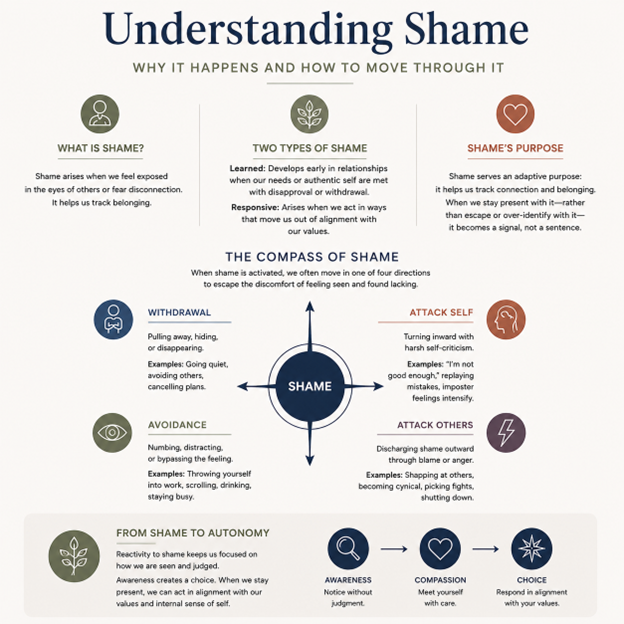
Shame often arrives in ordinary moments: a comment in a meeting that lands harder than expected, followed by the sudden heat in your face; being passed over for a project and replaying the decision on your drive home; realizing you’ve made a mistake and feeling the room shift, even if no one says anything. It can show up just as easily at home, in the moment your voice sharpens with your child and you see their reaction, in the quiet after an argument, or in the recognition that you’ve let someone down. These are the moments when our attention turns inward. We become aware of ourselves in the eyes of others, and that awareness carries a sense of exposure.
Shame is one of the most uncomfortable emotions we carry, and one of the least talked about. But it shows up more than we think. At its core, shame is the feeling that there is something fundamentally wrong with us. Not that we did something bad, but that we are somehow bad. It is less about behavior and more about identity. It may be avoided, minimized, or quickly covered over. And shame serves an adaptive purpose: it helps us track connection and belonging. When left unexamined, it can shape how we think, behave, and relate to others. When we learn to recognize it, shame can become an entry point into self-awareness and a more self-directed life.
Over time, our responses to shame can become patterned, pulling us toward reactivity and away from a more grounded sense of self. But shame can also be understood differently. Rather than something to escape, it can be approached as a signal pointing to where our sense of worth, belonging, or identity feels most vulnerable. Learning to stay with these moments, without immediately moving to fix or avoid them, creates space for awareness and choice. In that space, shame shifts from something that controls us to something we can learn from. And from this shift, a more self-directed way of living emerges, less organized around external validation and more grounded in internal alignment.
Shame can be learned, often developing early, in relationships where our needs, emotions, or authentic expressions are met with disapproval, withdrawal, or correction. In these moments, we may be aligned with ourselves, yet come to experience that alignment as unacceptable. Over time, this form of shame can distance us from who we are, shaping identity around what feels permitted rather than what feels true.
At other times, shame is responsive. It arises when we act in ways that move us out of alignment with our own values, especially when those moments are seen by others. Here, shame signals dissonance, drawing attention to the gap between who we are and how we have acted.
Both forms, while uncomfortable, hold potential. Learned shame invites us to question inherited beliefs about what is acceptable and to reclaim disowned parts of ourselves. Responsive shame invites reflection, accountability, and the possibility of realignment. In this way, shame, whether carried from the past or arising in the present, becomes a point of contact with deeper self-understanding.
Shame signals vulnerability and can shape how we respond to it. Psychiatrist Donald Nathanson described these patterned responses as the “Compass of Shame,” a framework that maps the common ways we move away from the discomfort of being seen and found lacking. Most of us default to one or two of these without realizing it. See if any feel familiar.
At the center of the compass is the experience of shame itself. From there, we tend to move in one of four directions:
Withdrawal — pulling away, hiding, or disappearing. At work this can be going quiet after a difficult presentation, or avoiding the colleague who witnessed your mistake. In our personal lives this may show up as cancelling plans after an argument, retreating from a friendship after saying the wrong thing
Attack Self — turning inward with harsh self-criticism. At work this may show up as replaying an error for days, imposter syndrome intensifying after critical feedback. At home we may say "I'm a terrible partner," "I always do this," "I don't deserve good things"- the inner critic running on a loop.
Avoidance — numbing, distracting, or bypassing the feeling. Here we can throw ourselves into work to stay busy, minimizing with "it's fine, it wasn't a big deal". At home this shows up as scrolling, drinking, staying surface-level in conversations, keeping busy so we don't have to feel it.
Attack Others — discharging shame outward through blame or anger. At work we can catch ourselves snapping at a direct report after being feeling criticized by your manager, becoming cynical or quietly checking out. At home we may pick a fight with a partner after feeling embarrassed, becoming cold or critical toward the people closest to us.
These responses are deeply human and often protective. They help regulate the intensity of exposure in the moment. But over time, they can become habitual pathways or automatic ways of moving away from our own experience. In doing so, they limit our capacity for awareness, connection, and choice.
This is where shame and a sense of personal freedom become linked.. Within Self-Determination Theory, autonomy refers to the ability to act in alignment with one’s own values and internal sense of self (Deci & Ryan, 2000). Reactivity to shame, organizes attention around external evaluation, how we are seen, judged, or measured by others. Being mindful and aware of shame creates the opportunity to be intentional, and aligned with our own values. In short, the more we understand our shame, the less it drives us.
Research reflects this pattern: shame is very painful, at it’s core is a feeling that one is unworthy of love, leading individuals to withdraw, show reduced initiative, and struggle with self-regulation (Brown, 2021). In contrast, this shift towards self-compassion allows individuals to remain present with feelings of inadequacy without collapsing into self-judgment (Neff, 2023). From that stance, curiosity, resilience, and self-directed action become greater autonomy (Deci & Ryan, 2000).
The work of transforming shame gradually builds the capacity to pause within challenging emotions, like shame. This pause interrupts the automatic movement away from experience and creates space to notice the humanity underneath: the vulnerability of being seen, the fear of disconnection, the wish to belong. In this way, shame and autonomy are dynamically related. Shame constricts the self around perceived deficiency; autonomy expands the self through awareness, ownership, and choice.
If shame feels familiar, persistent, or difficult to navigate on your own, you don’t have to work with it in isolation. These patterns often take shape in relationship, and they can be explored and transformed in relationship as well. It can begin with small steps: pausing to notice your response, naming the feeling, or meeting yourself with a bit more curiosity than judgment. And at times, additional support can make that process more accessible.
The Faculty & Staff Assistance Program (FSAP) offers confidential support for navigating challenges at work and in personal life. You can reach FSAP by calling (415) 476-8279 or visiting https://tiny.ucsf.edu/FSAP
References:
Brown, B. (2021). Atlas of the Heart. Vermilion.
Deci, E. L., & Ryan, R. M. (2000). The “what” and “why” of goal pursuits: Human needs and the self-determination of behavior. Psychological Inquiry, 11(4), 227–268. https://doi.org/10.1207/S15327965PLI1104_01
Nathanson, D. L. (1992). Shame and pride: Affect, sex, and the birth of the self. W. W. Norton & Company.
Neff, K. D. (2023). Self-compassion: Theory, method, research, and intervention. Annual Review of Psychology, 74, 193 to 218. https://doi.org/10.1146/annurev-psych-032420-031047
Sabina Brown, Psy.D., M.A.
Change at work can bring real feelings of loss and disruption. When colleagues or friends unexpectedly separate from employment while you remain, it’s natural to feel unsettled. Many people experience something akin to survivor guilt, that uneasy mix of gratitude, sadness, and concern for others. This can be part of an experience known as survivor syndrome; a term first used in the late 1990s to describe the experience of those who remain employed after major organizational change.
You might notice worry, fatigue, or uncertainty about the future. Some people feel less motivated or feel disappointed in their leadership; others simply feel unsteady as they adjust. These reactions are normal, and with time and care, they tend to soften.
In the days and weeks after change, it’s common to wonder, “Why them and not me?” or to feel sadness for those who left mixed with relief that you stayed. Even that relief can bring guilt or self-doubt. If you’ve felt any of this, you’re not alone, these are deeply human responses to loss and transition, and part of finding your balance again.
Researcher David Noer, who studies the human impact of organizational change, found that individuals impacted often share similar emotional reactions to large organizational shifts. He emphasizes that realignment is possible, and that individuals can grow through these experiences by acknowledging their feelings, rebuilding stability, and renewing a sense of purpose.
This guide offers ways to regain balance, care for yourself, and move forward through times of change. The strategies below are designed to help you adjust with confidence, renew your energy, and cultivate a sustainable sense of purpose in your work.
Acknowledge What You Feel
Big changes at work can bring up a surprising mix of emotions like relief, guilt, sadness, or even anger. These feelings don’t mean something is wrong with you; they’re natural responses to loss and uncertainty. The first step in moving through this experience is simply noticing what you’re feeling.
Try this: Take a few minutes each day to pause and name your emotions without judgment. Writing them down or saying them aloud can help transform what feels overwhelming into something you can hold and understand.
Create Small Anchors of Stability
When your work world shifts suddenly, it can leave you feeling unmoored. Rebuilding a sense of structure through small, steady routines, helps restore a feeling of safety and control. Even small habits can become touchpoints of calm in uncertain times.
Try this: Keep a simple daily rhythm; wake up around the same time, eat nourishing meals, and include one grounding activity like a short walk, a cup of tea, or five minutes of quiet before bed. Rest isn’t indulgent, it’s how we recover our strength.
Stay Connected
After unexpected employment separations or major changes, it’s easy to retreat or isolate. Yet connection is one of the strongest antidotes to stress. Talking with someone you trust can help you feel seen, supported, and less alone in your experience.
Try this: Reach out to a friend, family member, or colleague to share how you’ve been feeling. If others in your household are affected, invite honest conversations about what’s shifting and how you can support one another. If sadness or anxiety persist, consider reaching out to a mental health counselor for extra support.
Reconnect With Meaning
When everything feels uncertain, reconnecting with what truly matters can help you find your footing again. Your values can guide you back toward purpose and balance, even in changing circumstances.
Try this: Write down two or three personal values (for example; integrity, honesty, kindness) and choose one small way to live them at work or in daily life. You don’t need to prove your worth by doing more, showing up with integrity and care is enough.
Moving Forward
Change in the workplace can leave you feeling disoriented, especially when it touches the people and routines that once grounded your day. Within that disruption lies the opportunity to rebuild by caring for yourself in ways that make your work life more sustainable. Each small effort to restore balance, maybe setting clear boundaries, asking for support, or finding steady rhythms, helps you feel more present and capable. Over time, these small choices add up, creating a foundation of stability that allows you to move forward with confidence, purpose, and a renewed sense of connection to your work.
To make an appointment with a counselor at the Faculty and Staff Assistance Program (FSAP) you can submit your online request here (note: UCSF VPN access is required to view the form).
References
Appelbaum, Steven H., Claude Delage, Nadia Labib, and George Gault. “The Survivor Syndrome: Aftermath of Downsizing.” Career Development International 2, no. 6 (1997): 278–286. https://doi.org/10.1108/13620439710178639.
Noer, David M. Healing the Wounds: Overcoming the Trauma of Layoffs and Revitalizing Downsized Organizations. Rev. ed. San Francisco: Jossey-Bass, 1993.
Niederland, William G. “The Problem of the Survivor: Some Remarks on the Psychic Reactions of Long-Term Concentration Camp Survivors.” Journal of the American Psychoanalytic Association 9, no. 2 (1961): 313–321. https://doi.org/10.1177/000306516100900204.
Unexpected employment separation can be one of life’s most challenging experiences. It affects not just your work but also your sense of stability, identity, and relationships. You may be feeling a mix of emotions (anger, sadness, fear, shock, or uncertainty) and it’s important to know that these feelings are valid and natural. This is a difficult moment, and navigating it takes time.
While this experience is unique to each person, here are some ideas and perspectives that may provide support as you process this transition and begin to move forward at your own pace.
Acknowledging and Understanding Your Emotions
It’s okay to feel what you’re feeling. Emotions like anger, sadness, and grief are natural responses to unexpected loss. This moment may bring up questions about how and why this happened, as well as feelings of uncertainty about the future.
- Give yourself time and space to process. It’s normal to feel a range of emotions, and allowing yourself to acknowledge them, without judgment, can help in making sense of what has happened.
- Express your feelings in ways that feel right to you. Whether it’s talking with someone you trust, writing in a journal, creating art, or engaging in physical activity, finding healthy outlets for your emotions can be helpful.
- Recognize grief as part of the experience. Grief isn’t always linear, and it can take time to move through the different stages. You might find yourself circling back to feelings of denial, anger, or sadness even after reaching moments of acceptance. That’s okay, it’s all part of the process.
Routine & Taking Care of Yourself
In times of uncertainty, prioritizing your well-being can help provide stability and strength. For many people, going to work every day provides a sense of routine and structure. With that now gone, it’s normal to feel a lack of direction or stability. Creating new routines can help fill this gap and provide a foundation to keep you on track during this transition.
- Create a daily routine. Structure can be grounding, and small habits like waking up at a consistent time, eating nourishing meals, or setting aside time for meaningful activities can help you regain a sense of control.
- Focus on your health. Stress can take a toll on both your mind and body, so consider practices that support your physical and emotional well-being. Whether it’s going for a walk, preparing meals you enjoy, meditating, or connecting with spiritual or cultural practices, choose what feels most helpful for you.
Seeking Support
You don’t have to navigate this alone. Staying connected to people who care about you can make a big difference.
- Lean on your support system. Friends, family, and trusted colleagues can offer not just practical advice, but also emotional encouragement. Sharing your experience with others can help lighten the weight you’re carrying. It’s also okay to hold off on sharing until you feel ready.
- Communicate with those affected. If your employment separation is impacting others in your household, open a conversation about how to manage the changes together. Sharing concerns and ideas can help everyone feel more supported and included.
- Accept help when it’s offered. It can be hard to ask for or accept help, but leaning into the support others want to give can be a meaningful way to move forward.
Reframing the Experience
While it may not feel possible right now, this transition could eventually open new doors.
- Reflect on your strengths. Take time to recognize the skills, knowledge, and experience you’ve built over the years. These are valuable assets that you’ll carry into your next chapter.
- Practice kindness toward yourself. It’s easy to fall into self-blame or self-criticism during moments like this, but losing a job is almost always beyond your control. Treat yourself with the same compassion you’d offer a friend going through the same situation.
Exploring Resources
This is a time when reaching out to available resources can provide practical assistance and peace of mind.
- Tap into community services. There may be local or county resources available to help you with financial support, skill-building programs, or job placement services.
- Explore UCSF benefits. If you are eligible, review UCSF benefits that may be available to you both before and after your separation date.
- Seek professional support if needed. Adjusting to unexpected employment separation doesn’t follow a set timeline. If you’re feeling overwhelmed or stuck, a counselor or therapist can offer guidance and help you manage emotions, relationships, and transitions.
Moving Forward at Your Own Pace
This is a challenging time, and it’s okay to take things one step at a time. You don’t have to have all the answers right now, and your path forward will evolve as you gain clarity and confidence.
Remember, this transition doesn’t define your worth or your future. There are brighter days ahead, and when you’re ready, you’ll take the next steps toward them.
UCSF’s Faculty and Staff Assistance Program (FSAP) is here to support employees impacted by employment separation. Our services are available through the end of the calendar month of an employee’s separation date. Schedule a free and confidential appointment by calling (415) 476-8279.
Sierra Garthwaite, Psy.D.
Procrastination is a common challenge among professionals in high-demand fields, often arising from stress, perfectionism, fear of failure, and emotional avoidance. Rather than a time management issue, researchers increasingly recognize procrastination as a form of emotional regulation gone awry (Eckert et al., 2016). In this model, people delay tasks not because they don’t care, but because completing the task is associated with unpleasant emotions-like anxiety, boredom, or self-doubt.
Researchers have identified common procrastination styles: The Worrier, who hesitates due to fear of failure or self-doubt; the Perfectionist, driven by anxiety and a need to do things flawlessly; the Overdoer, overwhelmed by too many competing priorities; the Crisis Maker, who thrives under last-minute pressure; and the Dreamer, who believes goals can be achieved effortlessly without focused effort (Ai, 2025).
When procrastination becomes chronic, it can impact workplace productivity, personal satisfaction, and mental health. Symptoms may include racing thoughts, guilt, sleep disturbances, or avoidance behaviors such as scrolling, snacking, or rumination.
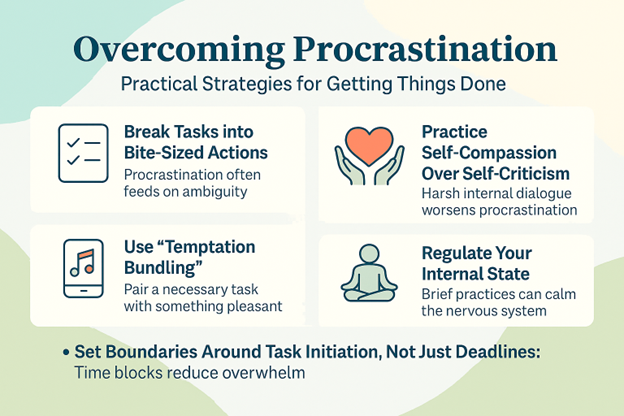
Fortunately, several strategies can help interrupt this cycle:
- Break Tasks into Bite-Sized Actions: Procrastination often feeds on ambiguity. Make a specific plan for when and how you will take action ("If it is 9 a.m., I will open the document") to anchor micro-goals.
- Practice Self-Compassion Over Self-Criticism: Harsh internal dialogue like “I am lazy” or “I always mess this up” can actually make procrastination worse. In contrast, using supportive internal dialogue; for example, saying to yourself, “I am doing the best I can right now” or “It is okay to make mistakes; I can still move forward” can be helpful in reducing the avoidance of tasks. A meta-analysis of interventions to reduce procrastination showed that cognitive behavioral therapy reduced procrastination more than other approaches (Eerde & Klingsieck, 2018).
- Use Temptation Bundling: Pairing a necessary task with something pleasant (e.g., listening to music while answering emails) has been emphasized as a method to improve task engagement. James Clear (2018) author of Atomic Habits shares in a website article practical tips on how to create temptation bundles.
- Focus on Managing Your Emotions, Not Just Your Schedule: Strategies like mindfulness meditation, physical activity, or short breathing exercises can calm the nervous system, reducing the emotional resistance to beginning tasks. Results of studies have shown that practicing emotion regulation skills which help individuals navigate aversive emotions reduces procrastination (Eckert et al., 2016).
- Set Boundaries Around Task Initiation, Not Just Deadlines: Establishing consistent boundaries and implementing structured time blocks can foster sustained engagement with tasks while easing overwhelm. Complementary practices such as maintaining regular sleep and exercise routines, nurturing relationships, and enjoying hobbies have been connected to lower risk of burnout (National Academies of Sciences, Engineering, and Medicine, 2019).
By addressing the emotional roots of procrastination and implementing manageable, research-backed strategies, we can begin to unstick ourselves and move forward with intention and greater clarity. At UCSF, resources like the Faculty & Staff Assistance Program (FSAP) can provide brief counseling to support professionals struggling with procrastination. Additionally, self-compassion classes and mindfulness-based stress reduction programs can serve as helpful resources.
Citations:
Marcus Eckert, David D Ebert, Dirk Lehr, Bernhard Sieland, Matthias Berking. Overcome procrastination: Enhancing emotion regulation skills reduce procrastination. Learning and Individual Differences, Volume 52, 2016, 10-18. https://doi.org/10.1016/j.lindif.2016.10.001
Ai, K. (2025). Task-specific visualization meditation can overcome procrastination. Arts, Culture and Language, 1(3). https://doi.org/10.61173/11aarf52
Wendelien van Eerde, Katrin B. Klingsieck. Overcoming procrastination? A meta-analysis of intervention studies. Educational Research Review, Volume 25, 2018, Pages 73-85, https://doi.org/10.1016/j.edurev.2018.09.002
Clear, James, author. (2018). Atomic habits: tiny changes, remarkable results: an easy & proven way to build good habits & break bad ones. New York, New York: Avery, an imprint of Penguin Random House. Article link: https://jamesclear.com/temptation-bundling
National Academies of Sciences, Engineering, and Medicine. (2019). Taking action against clinician burnout: A systems approach to professional well-being. Washington, DC: National Academies Press. https://doi.org/10.17226/25521
Further Reading:
- Neff, K. D. & Germer, C. K (2018). The Mindful Self-Compassion workbook: A proven way to accept yourself, find inner strength, and thrive. New York: Guilford Press.
- Fishbach, Ayelet (2022). Get it Done: Surprising Lessons from the Science of Motivation. UK: Pan Macmillan.
Sierra Garthwaite, Psy.D.
Feeling stuck or uncertain is a common experience, particularly in high-stress professional environments such as healthcare, academia, and leadership roles. Decision paralysis often arises when individuals face ambiguous outcomes, emotionally charged choices, or competing values.
Prolonged indecision can lead to emotional fatigue, decreased productivity, and disengagement from meaningful goals. Individuals who struggle to disengage from unattainable goals or delay decisions may report higher stress levels and diminished well-being. This tendency toward overthinking or avoidance is not due to laziness or disinterest. It is often a protective response to uncertainty or fear of making the "wrong" choice.
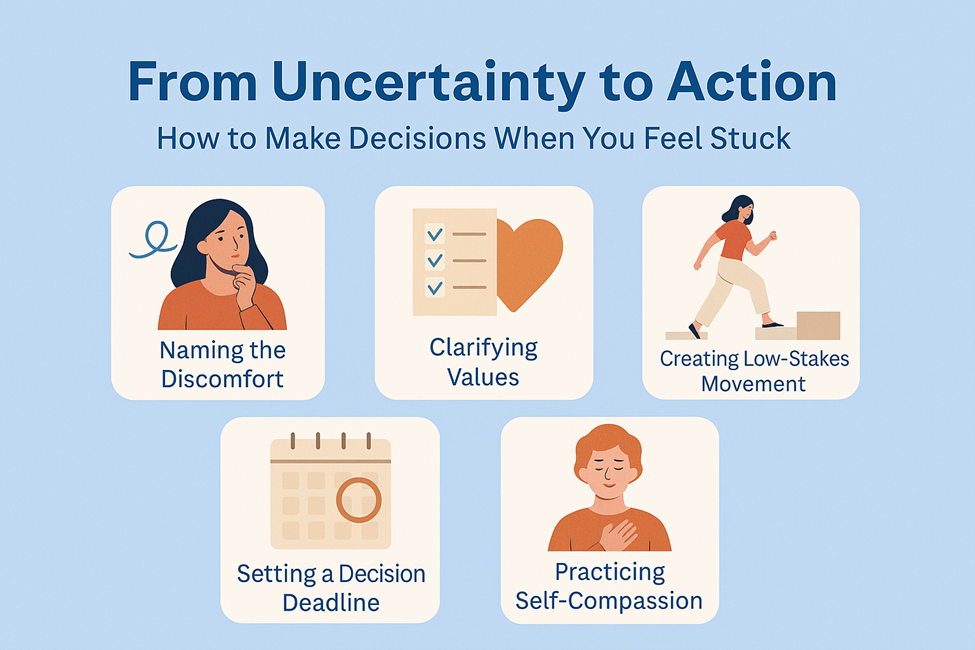
Fortunately, research also highlights practical tools for transforming uncertainty into action. Common strategies for moving from uncertainty to action include:
- Naming the Discomfort: Identify whether the stuckness is due to fear of failure, people-pleasing, anxiety related to perfectionism, or internal conflict between competing values. Morie et al. (2022) proposed that recognizing and identifying an individual's emotions can be a helpful initial step in starting the process of emotional regulation and taking effective action.
- Clarifying Values: Ask, “What’s most important to me in this situation?” The intrinsic theory of motivation suggests that motivation which stems from personal values and genuine interest tends to be more enduring, as it’s fueled internally rather than by external incentives (Bandhu et al., 2024).
- Creating Low-Stakes Movement: Rather than waiting for perfect certainty, try committing to a small action such as an email, a conversation, or a 10-minute planning session. Action-based “scaffolds” have been suggested as a framework to increase motivation through strategies such as frustration control (Belland et al., 2013). Small manageable steps can also increase chances of collecting more information to help inform a decision (Enachescu et al., 2021).
- Setting a Decision Deadline: When appropriate, set a gentle deadline and remind yourself: not all decisions require 100% certainty.
- Practicing Self-Compassion: Rather than judging yourself for indecision, validate the difficulty and recognize the courage it takes to pause and reflect. Kristin Neff (2011) found that higher levels of self-compassion have been related to greater life satisfaction, learning goals, depression, anxiety, and less fear of failure.
The Faculty & Staff Assistance Program (FSAP) offers tools and counseling support for those navigating complex life and career decisions. Ultimately, moving from uncertainty to action doesn’t mean eliminating fear. It means learning to act in the presence of it. Through values alignment, tolerating uncertainty, and self-compassion individuals can begin to move forward with clarity and confidence.
Citations
Morie, K. P., Crowley, M. J., Mayes, L. C., & Potenza, M. N. (2022). The process of emotion identification: Considerations for psychiatric disorders. Journal of psychiatric research, 148, 264–274. https://doi.org/10.1016/j.jpsychires.2022.01.053
Din Bandhu, M. Murali Mohan, Noel Anurag Prashanth Nittala, Pravin Jadhav, Alok Bhadauria, Kuldeep K. Saxena. (2024). Theories of motivation: A comprehensive analysis of human behavior drivers. Acta Psychologica, Volume 244. https://doi.org/10.1016/j.actpsy.2024.104177
Belland, B. R., Kim, C., & Hannafin, M. J. (2013). A Framework for Designing Scaffolds That Improve Motivation and Cognition. Educational psychologist, 48(4), 243–270. https://doi.org/10.1080/00461520.2013.838920
Enachescu, V., Schrater, P., Schaal, S., & Christopoulos, V. (2021). Action planning and control under uncertainty emerge through a desirability-driven competition between parallel encoding motor plans. PLoS computational biology, 17(10), e1009429. https://doi.org/10.1371/journal.pcbi.1009429
Neff, K. D. (2011). Self-compassion, self-esteem, and well-being. Social and Personality Psychology Compass, 5(1), 1–12. https://psycnet.apa.org/doi/10.1111/j.1751-9004.2010.00330.x
Further Reading:
Heath, Chip, & Dan Heath. (2013). Decisive: How to Make Better Choices in Life and Work. Crown Business.
Romy-Michelle Unger, PsyD.
Emotional regulation is the process of managing our feelings, and it is an important part of mental health (Gross, 1998; MacLeod & Conway, 2005; Hu et. al., 2014). It describes taking action to shift our emotional state to one that is more helpful or preferable. Emotional regulation often comes after the experience of becoming emotionally dysregulated, or feeling an inability to soothe emotions such as anxiety, sadness, or anger, and control how we act on them. Emotional dysregulation can mean that our nervous systems have entered into a fight, flight, or freeze response as a response to a perceived threat, even if there’s no obvious danger in front of us. Essentially, dysregulation takes us out of our baseline and “window of tolerance,” which describes the range of intensity we can tolerate before becoming overwhelmed by stress.
Emotional dysregulation often describes an up-regulation of our emotional state, or an increase of emotional intensity when faced with something we experience as threatening. Some examples of emotional dysregulation include mood swings, irritability, impulsivity, decreased tolerance for frustration, and a tendency to lose one’s temper. One way to notice if we’ve become excessively emotionally dysregulated is if we begin to engage in aggressive behavior, outbursts, crying more than usual, and repeated interpersonal conflicts.
Once we’ve found ourselves in an emotionally dysregulated state — perhaps while caught in a particularly long line at the DMV, or after a break-up, or perhaps after a challenging patient interaction at work — we often engage in emotional regulation strategies to cope, which can range from healthy to unhealthy. Unhealthy strategies include increased substance use, self-harm, doom-scrolling, and binge eating. Healthy strategies, on the other hand, can look like meditation, mindfulness, or deep breathing to calm the nervous system, journaling, exercise or intentional movement, or processing with a therapist or mental health professional.
The next time you notice yourself emotionally dysregulated (which is a huge step; it means you’re increasing self-awareness of your emotional state), take a moment and try to slow down. Take a few deep breaths. Notice the signs of dysregulation as they show up for you. Whether they’re the thoughts that are running through your mind, or the physical sensations, or even perhaps noticing the impact in your relationships — jot them down so you can build a language for yourself to notice your emotional states. Practice taking breaks and allowing yourself to cool off. If you’re noticing yourself getting heated, consider excusing yourself for the bathroom and splashing cold water on your face, or heading to the kitchen and placing an ice cube on your neck (Neacsiu, Bohus & Linehan, 2014). This can help literally and figuratively bring the temperature down.
Citations
Neacsiu, A. D., Bohus, M., & Linehan, M. M. (2014). Dialectical behavior therapy: An intervention for emotion dysregulation. Handbook of emotion regulation, 2, 491-507.
Gross, J. J. (1998). The emerging field of emotion regulation: An integrative review. Review of general psychology, 2(3), 271-299.
Hu, T., Zhang, D., Wang, J., Mistry, R., Ran, G., & Wang, X. (2014). Relation between emotion regulation and mental health: A meta-analysis review. Psychological reports, 114(2), 341-362.
MacLeod, A. K., & Conway, C. (2005). Well‐being and the anticipation of future positive experiences: The role of income, social networks, and planning ability. Cognition & emotion, 19(3), 357-374.
Kraiss, J. T., Ten Klooster, P. M., Moskowitz, J. T., & Bohlmeijer, E. T. (2020). The relationship between emotion regulation and well-being in patients with mental disorders: A meta-analysis. Comprehensive psychiatry, 102, 152189.
Romy-Michelle Unger, PsyD.
The grieving process after losing a loved one — be it a family member, partner, friend or colleague — is often met with sympathy, understanding, and grace. However, losing a pet can evoke just as deep a grief response as losing a human companion. While the death of a pet can be incredibly impactful on a person’s mental health, the culture around us doesn’t hold such a loss in the same regard, which can contribute to an experience known as disenfranchised grief, or grief that is believed to be illegitimate (Park, R., Royal, K., & Gruen, M., 2023). This can make the grieving process even more challenging for the bereaved, as they can be encouraged by family and friends to move on quickly and replace their pet before they are ready.
It’s important to acknowledge the role that our pets play in our lives. We form attachment bonds to our pets in ways that resemble the attachment bonds we have with relatives and chosen family (Sable, 1995). Pets are often a source of unconditional love that helps their humans navigate difficulties and losses, particularly when human contact was limited during the pandemic (Behler, Green, & Joy-Gaba, 2020). They are dependent on us as their caretakers in ways that help us keep a routine and stay motivated to keep going, even during the most isolating and challenging times.
Sometimes, because of the lack of social approval and support, it’s hard for us to acknowledge that losing a pet impacts us deeply. However, if you are currently experiencing grief from such a loss, it’s important that you give yourself the same grace that you would to anyone who is grieving the loss of a loved one. Feel your feelings as they arise, and give yourself the space to process the loss of your companion.
It is, of course, important to acknowledge that grief has its own timeline and may get activated outside of our conscious control. That said, there are rituals we can use to intentionally carve out space for ourselves to feel challenging emotions within an emotional container. For example, sometimes it can be helpful to set out a candle with a photo of your pet in an area of your home that feels private or special to you (or your pet). After lighting the candle, recall some special moments with your pet, particularly ones that bring up joy, while acknowledging the feelings of loss. Allow yourself to feel the spectrum of elation and grief as the emotions rise and fall. When you feel like you’ve reached capacity, or expressed the emotions you’ve wished to feel, you can blow out the candle. Lighting the candle can act as a symbol of containment for your grief, so you have agency to move in and out of your grieving process. If you feel comfortable, you can invite others to sit with you, and ask them to share their stories as well.
References
Behler, A. M. C., Green, J. D., & Joy-Gaba, J. (2020). “We Lost a Member of the Family”: Predictors of the Grief Experience Surrounding the Loss of a Pet. Human-Animal Interaction Bulletin, (2022).
Packman, W., Carmack, B. J., Katz, R., Carlos, F., Field, N. P., & Landers, C. (2014). Online survey as empathic bridging for the disenfranchised grief of pet loss. OMEGA: Journal of Death and Dying, 69, 333–356. doi:10.2190/OM.69.4.a.
Park, R. M., Royal, K. D., & Gruen, M. E. (2023). A literature review: Pet bereavement and coping mechanisms. Journal of Applied Animal Welfare Science, 26(3), 285-299.
Romy-Michelle Unger, PsyD.
Across cultures, civilizations, and epochs, humans have ritualized their grief via elaborate and time-consuming ceremonies in which whole communities will, for a time, shift their behavior, daily habits, food choices, and even their clothing. The utility of such a practice is that it creates a temporary “container” for the grief — a limited period of time during which daily, regular life has been suspended so that the bereaved can properly mourn and acknowledge that their lives have been forever changed by the loss of their loved one. Another important feature of this is that the community holds the loss with the bereaved, often involving themselves in the ceremony and aftercare providing for those most impacted by grief.
Regardless how these practices and ceremonies have looked or expressed themselves across cultures, they serve a similar function: to create space for the bereaved to process their loss, feel supported by their community, and transition into a new reality without their loved ones’ physical presence. In contrast, our modern, industrialized culture holds very little space for grief; outside of a funeral, memorial service, or obituary, very little communal space is made for individuals to process and feel supported in their bereavement. In fact, our culture largely incentivizes folks to quickly return back to “normal,” leading people to feel pressured to return to work as soon as possible so as not to compromise productivity.
What this can mean for many people is that, after an impactful loss, they may not have community-wide support to assist them in taking time off, pausing their daily activities, and deepening into their bereavement. Of course, many people continue to stay connected to cultural and religious practices that assist the bereaved, and it’s important to lean on such supports during times of loss. For others, however, it becomes even more important to give oneself the permission to take time off, find practices that can both contain and deepen the emotional experience, and remain connected to support systems of various kinds.
Death and dying can stir up deep religious, spiritual, or existential reflections. Whether someone draws meaning from a particular tradition, a secular worldview, or something in between, finding ways to ritualize grief can offer a powerful way to process and contain it.
Part 2 will cover how to ritualize grief.
Romy-Michelle Unger, PsyD.
A ritual is defined as a pattern of actions performed according to a prescribed order. Rituals are often parts of ceremonies, which tend to be more formal observances of collectively important events or occasions, but can also be performed in a secular, private capacity. Studies have shown that rituals help enhance our sense of control and help reduce anxiety (Brooks et al., 2016; Dygalatas, Maňo, & Pinto, 2021).
This is important because death and grief are experiences that lie largely outside of our conscious control. In a culture that is so focused on individual agency, grief can feel destabilizing as it is one of the human experiences that forces us to confront the limits of the control we have over our lives. Additionally, it’s an emotional experience that has traditionally been held by the community rather than the individual, whether that’s the extended family, religious community, or local network.
In order to regain a sense of agency in our lives, it’s important to think of ways that individuals can experience their grief within a container, or vessel. While historically, religious or cultural ceremonies stood as the container, we can explore ways to ritualize our grief in our own personal ceremonies as well. Setting up a small (or elaborate) altar can serve as a physical place to "put" our feelings, as well as offer us opportunities to honor the loved one we’ve lost in the privacy of our home.
Building an emotional container for our feelings also requires setting up a beginning and end point. This can look like lighting a candle to mark the beginning of the ritual, or lighting incense that shifts the sensory experience in the space. Additionally, it’s important to have a symbolic representation of the person we lost, such as a photo of them or a treasured keepsake that reminds us of them. After we’ve marked the beginning of the ritual, we can allow ourselves to relax into the emotional experience. Hold the keepsake or photo in your sight or even physically in your hands and invite the feelings to wash over you. If you feel called to speak something into the space, do so. This is a container for your feelings, however complicated and paradoxical they may be. It’s an opportunity to speak to sadness, anger, denial and disbelief.
After some time, you may feel "cooked," so to speak — like you’ve expressed what you needed to express and that it’s time to transition. Gently blow out the candle or the incense to signify the end of the ritual. You have now symbolically marked a transition away from the grieving experience, with the understanding that you can come back at any time.
References
Brooks, A.W., Schroeder, J., Risen, J.L., Gino, F., Galinsky, A.D., Norton, M.I., & Schweitzer, M.E. (2016). Don’t stop believing: Rituals improve performance by decreasing anxiety. Organizational Behavior and Human Decision Processes, 137, 71-85.
Xygalatas, D., Maňo, P., & Pinto, G.B. (2021). Ritualization increases the perceived efficacy of instrumental actions. Cognition, 215, 104823.
Losing a colleague can stir up a wide range of emotions, grief, confusion, guilt or even numbness, each shaped by the nature of our relationship with the person and the context of the loss. Grief is a uniquely human experience that moves in unpredictable waves, rarely following a straight line or fixed timeline. When the person we've lost is a coworker, the emotions may be complicated by questions about how much grief is "appropriate" in a professional environment.
These internal questions are often shaped by the broader culture we live in. Grief is not only personal, it is also sociocultural. Different cultures create different structures for mourning. For example, in Iranian culture, it’s common for colleagues of the deceased to attend the funeral, pay respects to the family, and participate in collective rituals of grief and remembrance. These communal practices provide a clear container for emotional expression and shared healing (Shoraka et al., 2022). In contrast, the dominant culture in the U.S. tends to view grief as private, often placing the burden on the individual to navigate loss independently, especially when the loss occurs within a professional setting.
This can create tension for employees grieving the death of a colleague, someone they may have spent countless hours with, collaborated closely with, or simply shared everyday moments beside. It can also feel disorienting to grieve someone with whom the relationship was meaningful but existed only in the workplace, without the context of family or personal history that society typically associates with mourning.
The complexity deepens when our relationship with the colleague was particularly close or, conversely, strained. We may grieve the loss of a trusted confidant, while feeling isolated from others who didn’t share that bond. Or we may feel conflicting emotions about unresolved tensions or difficult interactions, making our grief feel messy or tinged with guilt, resentment, or confusion. All of these emotional responses are valid.
Even if we didn’t personally know the colleague who passed, it’s normal to feel shaken. Death within our workplace community often touches on larger existential questions, fears, or memories of our own losses. We may find ourselves grieving not just the person, but the stability, energy, or culture that they helped shape in our work environment.
There is no "right way" to grieve. And there’s no timeline for when we should feel "back to normal," particularly when the normal we knew has been altered by someone’s absence.
Strategies for coping with the loss of a colleague
- Acknowledge and normalize your feelings: Whether you're feeling sadness, anger, guilt, confusion, or even relief, these are natural reactions. There is no hierarchy of "acceptable" emotions in grief.
- Create or participate in a shared ritual: Consider lighting a candle, sharing stories, or creating a memory board with your team. Rituals don’t have to be religious to be meaningful. They can provide structure for expressing and containing loss.
- Check in with colleagues: Grief often isolates. Making space to connect, even briefly, with coworkers to ask how they’re doing can foster a sense of support and shared humanity.
- Give yourself (and others) grace: Concentration may be harder. Energy may dip. People may react in ways you don’t expect. Extend compassion to yourself and your team as everyone processes the loss in their own way.
- Create space, if needed: Offer yourself small breaks throughout the day — whether that’s stepping outside, taking a quiet lunch, or speaking with someone you trust — to regulate and process your emotions.
- Use available support resources: Many workplaces, including ours, offer confidential counseling (FSAP) or grief support resources (Spiritual Care Services). Seeking help is not a sign of weakness. It’s a powerful step toward integrating loss in a healthy way.
- Honor their impact in your own way: Whether it’s reflecting on a lesson you learned from them or simply remembering a kind gesture, giving their presence continued meaning can be grounding.
- Respect differences in grief styles: Some colleagues may want to talk and share. Others may prefer to process internally. Avoid assumptions and allow space for everyone’s style of coping.
Grief in the workplace is real and often underestimated. By acknowledging it, supporting one another, and creating compassionate space, we can weather loss not only as individuals, but as a community.
Reference
Shoraka, H. R., Hashemi, S. A., Asghari, D., Chegeni, M., Arzamani, N., Sadidi, N., & Kaviyani, F. (2022). Mourning during COVID-19 pandemic in Bojnurd, a City in Northeast of Iran: A qualitative study. Journal of Iranian Medical Council.